

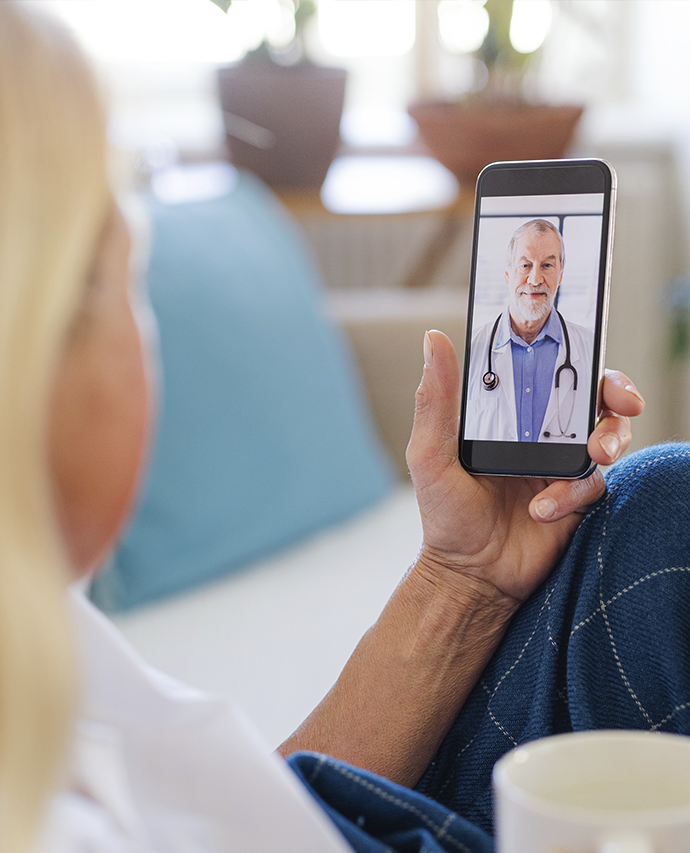
Types of Telehealth: Modalities
Mobile health (mHealth) is health care and public health information provided through mobile devices. The information may include general educational information, targeted texts, and notifications about disease outbreaks.
Over 97,000 health and fitness applications are currently available for mobile and tablet devices, according to HealthWorks Collective.
According to EMarketer reports, more than 87% of US smartphone owners have used health and fitness apps in 2020. Zion Market Research expects the mobile health apps market to exceed $111 billion by 2025, which represents a compound annual growth rate of 38% from 2019 [Health Informatics, 2020].
As apps and other mHealth technologies become more integrated into the healthcare system, the days for new and favorable impacts on health outcomes are more present [Referral MD, 2019].
The benefits of Mobile Health technology continue to evolve. Mobile Health Apps have proliferated across both iOS and Android platforms and has become a crucial perpetrator of growth and continues to revolutionize the healthcare sector as more people are now able to take control of their own healthcare needs with health applications in their smartphones, wearables, tablets, or other digital technologies [Health Informatics, 2020].
Mobile health yields positive outcomes for both patients and healthcare professionals by enabling patients to send secure messages, schedule appointments, and connect to providers 24/7 for telehealth needs. Some of the key benefits of mobile health technologies include:
Mobile Health modalities allow patients to maintain consistent contact with their physicians through virtual consultations, rather than relying on in-person appointments – thus adding to the overall convenience [Cure ATR, 2021].
Mobile Health provides remote care for elderly patients who need constant support due to chronic conditions and for those patients who cannot easily leave their homes [Health Informatics, 2020].
The Mobile Health modalities and technologies help patients to have access to their essential health information quickly, which could minimize extra costs such as for unnecessary hospital visits. With this, patients are also able to monitor their own medical conditions and be proactive about potential treatments [Health Informatics, 2020].
Mobile Health technologies help in tracking symptoms in real-time for quick diagnoses and soliciting expert feedback. With this, patients can track conditions in between visits, and notify a physician if there is a significant variation in the biological data, which could put any patient at risk.
With the help of Mobile Health modalities, patients have the access to personalized health data and treatment programs.
Mental Health technologies help in reducing human errors through electronic record-keeping and real-time data collection.
With Mobile Health modalities and virtual appointments, the spread of disease and infection is considerably reduced.
Poor adherence to the medication schedule is one of the prime reasons for poor management of a patient’s chronic condition. Mobile Health modalities provide prompt reminders to the patients to take their medicine, check their vitals or record their symptoms without the need for any intervention from the physician [Health Informatics, 2020].
However, there are challenges in implementing Mobile Health modalities. Some of these challenges include:
Usability poses a huge challenge to Mobile Health implementation. It is vital to adopt simplicity for Mobile Health applications, and this is a critical challenge that needs to be overcome [NCBI, 2019].
Many Apps do not have the capacity to update, merge and use under different conditions of technology and devices. This needs to be addressed to have effective Mobile Health accessibility.
Patient data is critical to the treatment and security aspects must be adhered to.
Due to connectivity variations, apps and devices tend to perform with varying efficiency and accuracy-based positioning. One relevant factor in this assessment is availability of network connectivity.
The availability and affordability of network access, speed and signal strength are crucial elements in the operations of health systems.
Most health professionals are technologically challenged and lack the skill to handle certain high-definition apps and devices. Illiteracy has always been a problem when it comes to technical issues.
Policy regulation, regarding the type of intervention to be used for a particular disease, have not been formulated in most countries
Cost of Apps and devices is a setback to a successful deployment of projects.
The correlation between service providers and the sociocultural needs of individual customers and communities have not been established [Research India Publications, 2019].
It is important to note that readily available apps often target the younger population. They do not optimize elderly use and fewer applications are found in the field of elderly health and elderly self-care. Technologies can support the empowerment of patients and families by allowing them to be actively involved in their healthcare [Journal of Education and Health Promotion, 2021].
Mobile Health is a much-needed boon for improving the healthcare delivery process. However, these challenges call for a focus on areas in need of change. Some of the feasible solutions for these challenges would include identification of storage locations when cloud computing is in use, the usability analysis of Mobile Health applications, and reliability analysis of Mobile Health applications before use. It will be interesting to observe how some of these challenges will be resolved in the years to come [NCBI, 2019].
Mobile Health takes many forms. As the demand continues to surge, we see the number of health applications for smartphones, wearables, tablets, and other digital technologies also growing [Health Informatics, 2020].
The climbing costs of healthcare services, hospital stays, shortages of healthcare facilities and of nurses and other skilled personnel have also put pressure on the medical systems to provide more care on an outpatient basis [National Academic Press, 2021].
This is having a cascading effect on the Mobile Health infrastructure and related technology too.
Telehealth Equipment: The equipment used to collect data in the home environment and transmit the data to a remote monitoring site.
[National Academic Press, 2021]
Patients can also use health and fitness apps to track their personal health data, such as their insulin levels and body temperature. Providers can also access this data in real time to quickly make diagnoses, identify life-threatening changes in vital statistics and analyze sudden symptoms [Health Informatics, 2020].
Wearable medical devices, such as smart watches, are also growing in popularity. According to Global Market Insights, the market for these products is expected to reach $87 billion by 2025, up from $8 billion in 2018. The iTBra, for example, can detect cancer in breast tissue, and the Apple Watch can track atrial fibrillation based on heartbeat data [Health Informatics, 2020].


